Peptide Purity Evaluation Solution
Understanding Peptide Purity: What 99%+ Truly Implies
Imaginative Proteomics is a trusted service provider of proteomics analysis services. Many thanks to our exceptional researchers and powerful mass spectrometry platform, we off supplies worldwide customer with comprehensive and professional peptide purity analysis solution by utilizing RP-HPLC. If you have any kind of questions or certain requirements, please feel free to call us.Inconsistent fragment size distribution and morphology can impact bioavailability and security. BOC Sciences is equipped with tools like DLS, TEM, SEM, etc, to completely evaluate nanoparticle dimension, circulation, and microstructure. For us, pureness isn't simply a portion-- it's a guarantee of integrity, consistency, and respect for the scientific research being done.
Make-up & Content
The purity of peptides is usually checked making use of high-performance fluid chromatography (HPLC). HPLC separates peptides based on their interactions with a fixed phase, enabling impurities and by-products to be recognized and evaluated. Additionally, mass spectrometry (MS) can be made use of to validate the peptide's molecular weight and series, providing more confirmation of purity by identifying contaminants and degradation items. If you have actually ever before obtained a synthetic peptide for a lab experiment, you have actually likely saw a purity percentage on the certificate of analysis-- usually worths like 95%, 98%, or even 99%. Peptide purity is an important high quality metric that tells you what portion of a peptide sample is the desired item versus unwanted byproducts.
Various other spectroscopic methods, such as Infrared (IR) or UV-Vis evaluation, are often utilized for quick high quality checks or structural confirmation. This is why reputable providers offer both HPLC and MS data on their Certificates of Analysis. Peptides in microspheres and nanoparticles may with matrices, making it challenging to divide complimentary and encapsulated types. We make use of dialysis, ultrafiltration combined with HPLC/UV approaches to scientifically assess encapsulation effectiveness and drug loading. These analyses are beneficial when clients need more than a mass range and chromatogram to judge whether a whole lot is really suitabled for quantitative work.Solutions
If the COA provides "complete impurities", that enhances the purity figure (e.g., 98% purity indicates 2% total contaminations). Lots of COAs additionally specify recognized or "specified impurities" versus unspecified ones, each with their specific percents if above a certain threshold. This level of detail assists scientists comprehend if any type of small peptide spin-offs are present. If you see numerous huge heights of comparable elevation, you're checking out either a low-purity sample or a mix. If the main optimal has a visible "shoulder"-- a bump on one side-- that usually shows a closely related contamination (like a deletion peptide) that the column couldn't fully fix. The peptide is travelled through a straightforward purification step (commonly gel filtering or a quick reversed-phase cleaning) to get rid of salts, small-molecule byproducts, and scavengers from the bosom action.
FDA and the European EMA have developed standards mandating extensive analysis and quality control for peptide items to guarantee security and effectivenessr. In the context of pharmaceutical or clinical-grade peptides, research laboratory validation is indispensable to satisfying these guidelines. As an example, prior to a peptide medicine can enter human trials, its manufacturer must show the identity, pureness, strength, and safety and security of the peptide via confirmed analytical approaches. Peptide purity screening data are obligatory in preclinical research studies and must be consisted of in investigational new drug (IND) applications and later brand-new medicine applications (NDAs).
Reviewing Mass Spectrometry Results On A Coa
- It guarantees you that the peptide will certainly carry out well in experiments (assuming purity and identity are as mentioned), yet it additionally lugs the caution "Study Usage Only." This expression is typically printed on the vial or documents.
- It's feasible to have a peptide that is, say, 95% pure by HPLC and yet the internet peptide content is something like 70% of the powder's weight (the rest being water and salts).
- This method divides peptides from impurities and measures both target peptides and pollutants, ensuring high-quality examples for study.
- The most rigid grade, including careful HPLC filtration-- occasionally multiple rounds-- and strenuous QC.
- Hydrophobic peptides, extremely basic sequences, modified constructs, and very closely relevant analogs can be reviewed with technique modifications matched to their logical threats.
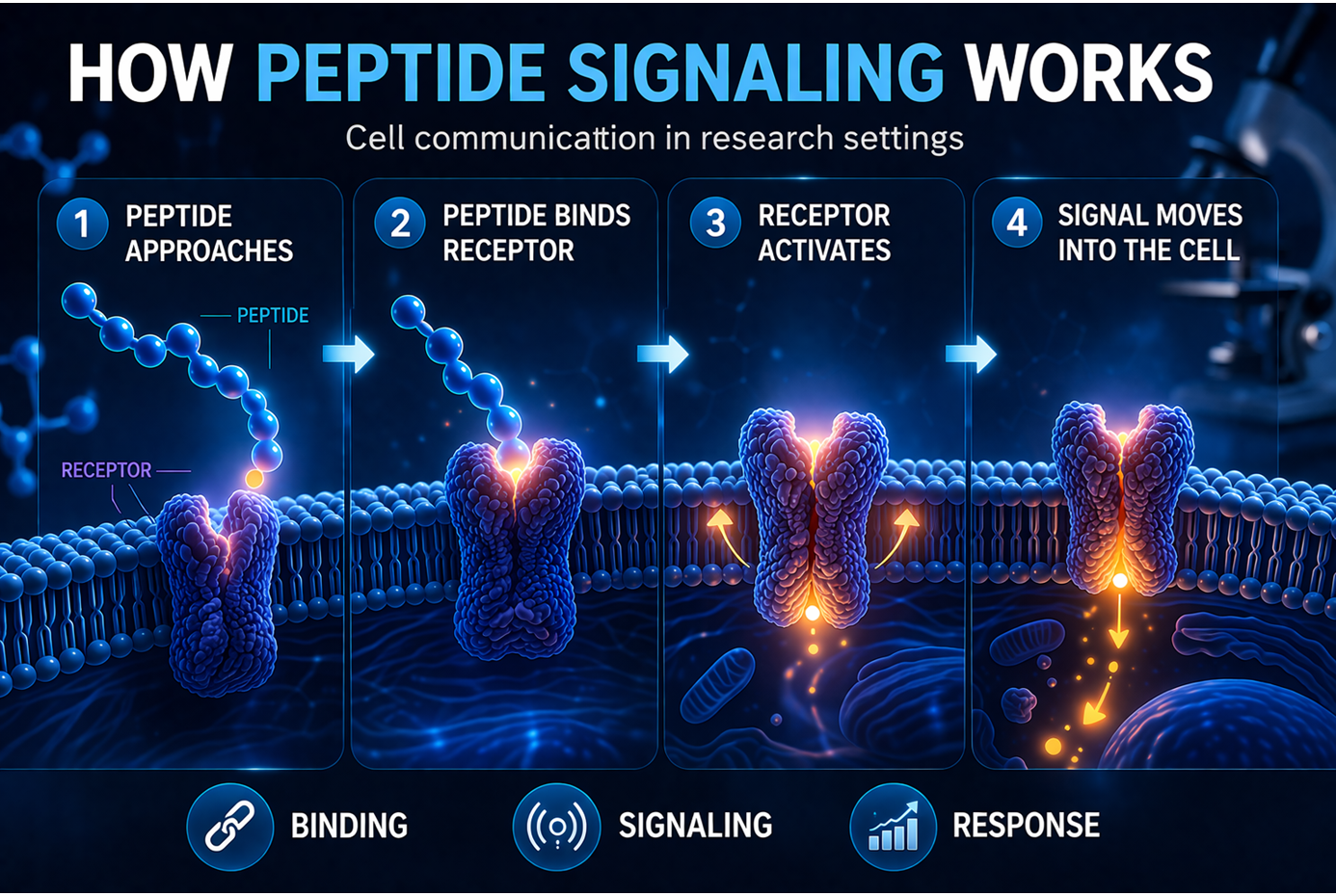
An example could generate a clean-looking chromatogram with one dominant optimal and still be the wrong compound if identification was never ever validated. HPLC measures splitting up and family member peak area; mass spectrometry actions mass-to-charge behavior that can be made use of to confirm molecular identity. Peptide purity testing is the procedure of validating that a peptide sample consists of just the intended series-- and no considerable impurities or by-products from synthesis. Due to the fact that peptides are developed with intricate chemical procedures, trace contaminations can form naturally. Testing allows scientists to comprehend exactly what's in the vial, verifying both identification and high quality. Choosing a credible third-party laboratory is essential to obtaining trustworthy peptide validation results.
While peptide purity isn't the only element, using poorly defined reagents is an identified contributor to irreproducible outcomes. For a 10-residue peptide with 99.5% coupling efficiency, you 'd expect concerning 95% of the final product to be the unabridged sequence prior to filtration. For a 30-residue peptide at the very same performance, that goes down to approximately 86%. This is why longer peptides are tougher to create at high purity and generally cost more. Pureness is the portion of publications in the shipment that have every web page printed properly, in the appropriate order, without missing phases and no extra pages packed in. A 95% pureness Click for source implies that out of every 100 "publications" in your batch, 95 are excellent duplicates and 5 have some type of error. Each peptide has a different anticipated molecular weight, so mass verification is not a generic badge; it is compound-specific proof. For a deeper identity-focused description, see Mass Spectrometry Peptide Confirmation. Identification testing validates that what was synthesised is actually the read more desired sequence.